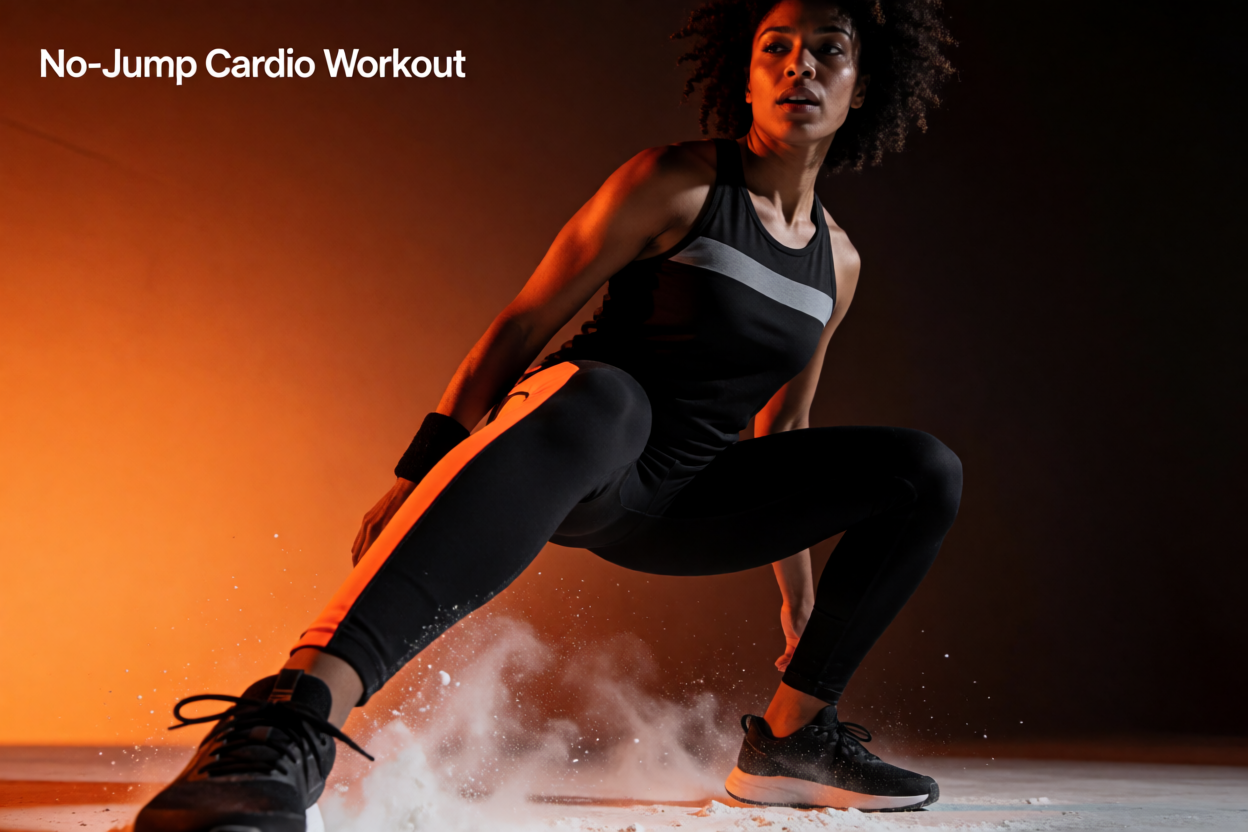
No-Jump Cardio Workout: Powerful Moves for a Great Burn
No-jump cardio workout builds endurance while protecting your joints. Controlled, rhythmic movements can deliver strong results in your living room.
This routine combines standing exercises with lower-body strength and upper-body work. This mix creates a balanced session that challenges your whole body. You need no fancy equipment because your body weight provides enough resistance.

For better results, work for 30 seconds, then recover for 30 seconds. This interval plan makes the no jump cardio workout fit any fitness level. Beginners and seasoned athletes can adjust the intensity for their goals and daily energy.
Key Takeaways
- Achieve a high heart rate without high-impact jumping movements.
- Combine strength and aerobic exercises for a full-body training effect.
- Utilize a 30-second interval pattern to manage your exertion levels.
- Perform the entire routine at home with minimal space and equipment.
- Maintain controlled, steady movements to ensure safety and effectiveness.
Prepare Your Body for a Low-Impact Cardio Session
Preparing for movement helps you stay safe and focused. When you commit to low impact cardio at home, you protect your joints and build endurance. Good preparation helps you shift from daily life into a focused exercise mindset.
Set Up a Safe, Quiet Workout Space
Your environment affects how well you move. A quiet cardio workout uses smooth transitions, not heavy impact, so choose space for full arm and leg extension.
Choose Supportive Shoes and Clear Enough Room to Move
Wear athletic shoes with cushioning to support your arches and ankles. Remove furniture, rugs, and clutter that could cause trips during side-to-side movements. Leave room to march in place, perform lunges, and reach overhead safely.

Use the Talk Test to Select Your Starting Intensity
Finding the right effort supports long-term progress. The talk test offers a simple way to measure effort during your session. If you can speak in full sentences without gasping, you likely have a sustainable aerobic effort.
Adjust Your Pace So You Can Move Without Losing Control
If you cannot speak, slow down at once. Control matters more than speed when you want to prevent injury. Use steady, rhythmic breathing to keep your heart rate comfortable throughout the routine.
Warm Up Your Joints and Major Muscle Groups
A proper warm-up prepares your body for a quiet cardio workout. Spend five minutes gently waking your muscles to increase blood flow and improve your range of motion. This reduces stiffness and helps you use better form.
Practice Marching, Arm Circles, Hip Hinges, and Easy Squats
Use this simple sequence to prepare your body for the main session:
- Marching: Lift your knees gently while swinging your arms to get your heart rate up.
- Arm Circles: Rotate your shoulders forward and backward to loosen the upper body.
- Hip Hinges: Keep your back flat and hinge at the hips to engage your glutes and hamstrings.
- Easy Squats: Perform shallow squats to activate your quadriceps and prepare your knees for deeper movement.
These steps make your low impact cardio at home experience effective and enjoyable. Consistency starts with a safe, prepared environment.
Follow This No Jump Cardio Workout Step by Step
Get a strong heart-rate boost without leaving the floor. This no jump cardio workout protects your joints while building endurance. Controlled, rhythmic movements create a lasting fitness foundation.

Step 1: March Briskly With Coordinated Arm Swings
Drive Through Your Feet While Keeping Your Torso Tall
March in place and lift your feet just enough to clear the floor. Keep your posture upright, as if a string pulls your head toward the ceiling. Engage your core muscles to steady your spine while your arms swing with each step.
Step 2: Add Step Touches for Side-to-Side Movement
Reach Your Arms Across Your Body Without Bouncing
Step your right foot out, then tap your left toe beside it. Repeat on the other side to keep a steady flow. Keep movements smooth and avoid bouncing for a true beginner cardio workout.
“Consistency is the bridge between your current goals and your future results. Small, steady movements performed with intention create lasting change.”
Step 3: Perform Alternating Knee Drives
Brace Your Core and Lift Each Knee Only as High as Comfortable
Stand with your feet hip-width apart and shift your weight to one side. Lift your opposite knee toward your chest while keeping your torso tall and steady. You do not need a certain height; focus on the controlled contraction of your abdominal muscles.
Step 4: Complete Low-Impact Jack Taps
Tap One Foot Out at a Time Instead of Jumping
Use this safer option instead of traditional jumping jacks. Tap your right foot to the side while your left foot stays planted. Alternate sides quickly to raise your heart rate without jump impact.
| Movement | Primary Focus | Intensity Level |
|---|---|---|
| Brisk March | Warm-up | Low |
| Step Touches | Lateral Motion | Moderate |
| Knee Drives | Core Stability | Moderate |
| Jack Taps | Heart Rate | High |
Build Strength With Lower-Body Cardio Moves
Build your fitness with slow, controlled lower-body movements. These exercises provide cardio without jumping while building muscle endurance. A slower pace keeps muscles working longer and raises your heart rate.

Step 5: Use Bodyweight Squats for a Stronger Burn
Send Your Hips Back and Keep Your Knees Tracking Over Your Toes
Squats are a basic move for any effective workout. Start by pushing your hips back, as if sitting in an invisible chair.
Keep your knees lined up over your toes as you lower. This position protects your joints and works your glutes and quadriceps.
Step 6: Add Reverse Lunges With Controlled Knee Drives
Step Back Carefully and Press Through Your Front Foot
Reverse lunges safely challenge your balance and leg strength. Step back with one foot, then lower until both knees make 90-degree angles.
As you rise, lift your back knee toward your chest. Press firmly through your front heel to work your muscles and keep a steady, rhythmic pace.
Step 7: Perform Alternating Side Lunges
Keep the Extended Leg Long While Bending the Opposite Knee
Side lunges work your inner and outer thighs and add variety. Step to the side with your chest upright and core engaged.
Keep your extended leg straight while bending the other knee. This sideways move makes your body stabilize, supporting high-quality cardio without jumping.
Step 8: Finish the Lower-Body Block With Calf Raises
Rise Slowly, Pause at the Top, and Lower Your Heels With Control
Calf raises finish this strength block well. Stand tall and rise onto the balls of your feet, using your full range of motion.
- Pause at the top for one second to maximize the contraction.
- Lower your heels slowly to the floor to increase time under tension.
- Maintain a deliberate, controlled pace to keep your heart rate elevated.
Increase the Burn With Standing Upper-Body Moves
You can create a full-body burn without touching the floor or jumping. Add upper-body cardio to raise your heart rate while keeping both feet on the ground. This turns a simple session into a standing cardio workout that challenges your muscles and lungs.

Step 9: Combine Punches With a Steady March
Punch Forward From Your Shoulders Without Locking Your Elbows
March in place to keep a steady rhythm. While your feet move, extend your arms forward with controlled punches. Drive each punch from your shoulders, not your wrists, and keep your elbows soft to protect your joints.
Step 10: Perform Standing Cross-Body Crunches
Bring the Opposite Elbow and Knee Together Without Pulling on Your Neck
Engage your core by lifting your right knee toward your left elbow. Focus on a controlled contraction in your abdominal muscles. Keep your hands lightly behind your head, and never pull on your neck.
Step 11: Add Squat-to-Reach Repetitions
Reach Overhead as You Stand and Keep the Movement Smooth
This move works your lower body and reaches overhead to increase your cardio without jumping. Do a shallow squat, then reach toward the ceiling as you stand. Move smoothly to keep steady tension through your body.
Step 12: Use Powerful Arm Pulses During a Recovery March
Keep Your Feet Grounded While Moving Your Arms at a Challenging Pace
During your recovery march, keep your feet firmly planted and pulse your arms back and forth. This keeps your heart rate elevated during active rest. Move your arms at a challenging pace so the sequence stays intense.
| Exercise | Primary Focus | Intensity Level |
|---|---|---|
| Standing Punches | Shoulders & Arms | Moderate |
| Cross-Body Crunches | Core & Obliques | High |
| Squat-to-Reach | Full Body | High |
| Arm Pulses | Endurance | Moderate |
Turn the Moves Into a Beginner Cardio Workout at Home
A home exercise plan lets you control your movement’s intensity and duration. Organizing these exercises creates a beginner cardio workout that fits your daily schedule.
Choose a Work-and-Rest Structure That Matches Your Fitness Level
Start With 30 Seconds of Work and 30 Seconds of Recovery
A balanced plan supports long-term success. Start with 30 seconds of active movement, followed by 30 seconds of rest. This rhythm lets your heart rate recover while keeping your muscles engaged.
Complete the Routine as a Quiet Cardio Circuit
Perform Each Move Once, Then Repeat the Circuit for Two to Four Rounds
For an effective quiet cardio workout, perform all twelve steps in order. After the full list, take a longer break if needed before the next round. Depending on your available time, complete two to four rounds for a comprehensive no jump cardio workout experience.
Modify Cardio Without Jumping for Sensitive Joints
Shorten Your Range of Motion, Slow Your Pace, or Hold a Stable Surface
If discomfort occurs, adjust the intensity to protect your safety. Shorten your range of motion or slow your pace to stay comfortable. Holding a sturdy chair or wall adds stability during your low impact cardio at home.
Make the Workout Harder Without Adding Impact
Increase the Work Interval, Add Light Hand Weights, or Use Faster Arm Movements
When you feel stronger, progress without adding high-impact jumps. Increase your work interval to 45 seconds or use light hand weights for more resistance. Faster arm movements can also raise your heart rate.
| Intensity Level | Work Duration | Rest Duration | Recommended Rounds |
|---|---|---|---|
| Beginner | 30 Seconds | 30 Seconds | 2 Rounds |
| Intermediate | 45 Seconds | 15 Seconds | 3 Rounds |
| Advanced | 60 Seconds | 15 Seconds | 4 Rounds |
Recognize Warning Signs and Cool Down Safely
Stop for Sharp Pain, Dizziness, Chest Pain, or Unusual Shortness of Breath
Listen to your body during training. Stop immediately for sharp pain, dizziness, chest pain, or unusual shortness of breath. After your final round, use a gradual cool-down to safely return your heart rate to rest.
Conclusion
Reaching your health goals takes consistency and a smart approach to movement. This no jump cardio workout supports heart health while helping protect your joints.
Combine cardiovascular conditioning with strength-focused movements for a complete routine. With cardio without jumping, you can maintain high intensity through controlled movements and steady pacing.
Begin with 30-second work intervals to build a strong foundation. As your stamina improves, progress to two to four circuit rounds.
Protect your safety by wearing supportive footwear, such as Brooks or New Balance sneakers. Keep your workout area clear of obstacles to prevent slips or trips.
Listen to your body during every movement. Stop immediately and recover if you feel sharp pain or dizziness. Your commitment to proper technique supports long-term success in your fitness journey.
FAQ
How can I ensure my low impact cardio at home is effective?
You can create a powerful burn with controlled movements and a steady pace through each circuit. Use the talk test: You should speak in short sentences while your heart rate climbs significantly. Supportive footwear, such as Nike Air Zoom trainers, keeps you comfortable and protects your joints during side-to-side movements.
What makes this a quiet cardio workout?
Without jumping, you avoid the heavy impact and “stomping” sounds of traditional HIIT sessions. Step touches, knee drives, and calf raises keep you active and burn calories without disturbing neighbors or family members. This routine suits people living in apartments or exercising early in the morning.
Is this beginner cardio workout adaptable for different fitness levels?
Absolutely. Start with a 30-second work interval and a 30-second recovery interval to build stamina. To progress, increase work intervals to 45 seconds, add Peloton light hand weights, or use faster arms in standing punches.
What are the key exercises involved in cardio without jumping?
This routine uses brisk marching, alternating side lunges, bodyweight squats, and standing cross-body crunches. These moves engage your core and major muscle groups while keeping your feet grounded. Low-impact jack taps and squat-to-reach repetitions work your full body without explosive vertical movement.
How should I prepare my body for a low-impact session?
First, clear a safe space at home for wide lateral movements and overhead reaches. Warm up your joints with arm circles, hip hinges, and easy squats. This gradual movement increase prepares your muscles for the circuit and helps prevent strain or injury.
What should I do if I experience pain or discomfort?
Safety comes first. If you feel sharp pain, dizziness, chest pain, or unusual shortness of breath, stop immediately. For minor joint sensitivities, shorten your range or use a sturdy chair or Stott Pilates barre during lunges and squats.
How many rounds of this circuit should I complete?
For a complete session, perform each move once, then repeat the circuit for two to four rounds. This volume provides enough cardiovascular conditioning and allows a gradual cool-down. During the cool-down, your heart rate safely returns to its resting state.